
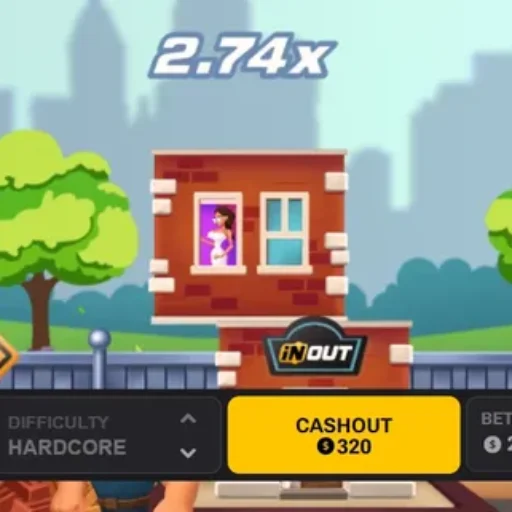
Play the Mega Block game
MegaBlock by Inout Games | Test, Feedback & Game Tips
Editorial rating: 4.3 / 5
What made me come back the next day was the difficulty selector. Being able to switch between Easy, Medium, and Hard from one round to the next is a freedom that no other crash game offers. The rest of this article tells what I discovered while digging deeper.
Chronicle of a first evening on MegaBlock
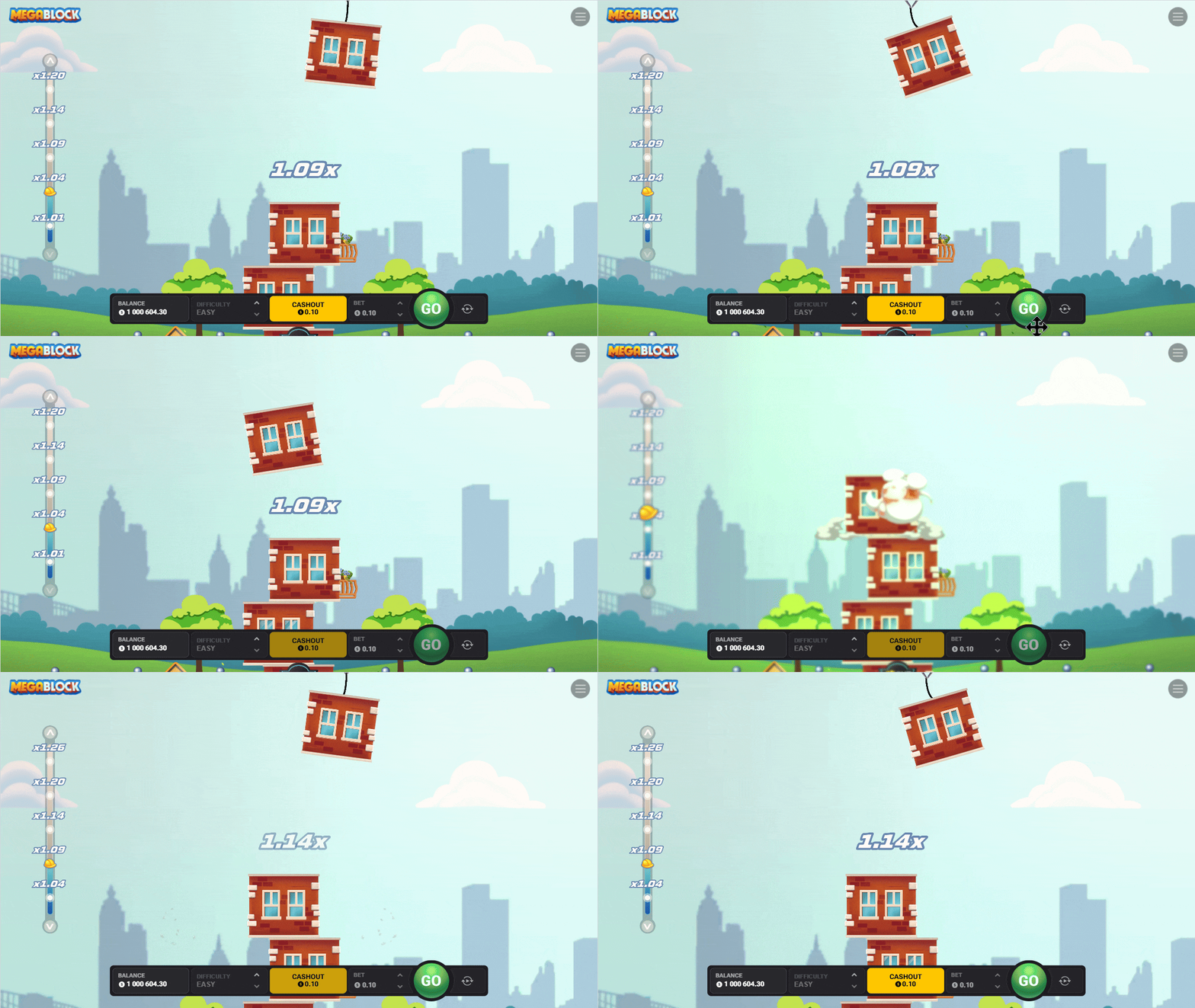
9:15 PM. Demo launch. The balance shows 1,000,000 credits. I start on Easy, bet of 5 credits. The first block sways slowly at the end of the crane. Click. It lands cleanly. The multiplier goes to x1.04. Nothing spectacular, but the movement is pleasant. Smooth.
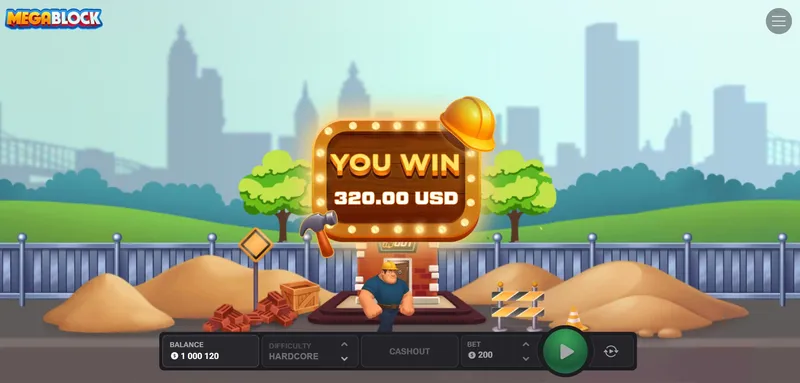
9:18 PM. Ten rounds on Easy. Eight successful cashouts, all between x3 and x5. Two rounds collapsed on the sixth floor. Result: +28 credits. The game is readable, the animations clear. The construction site decor with the crane, piles of sand, and the character in a yellow helmet has a friendly vibe that contrasts with the dark atmospheres of the competition.
9:22 PM. First attempt on Hard. The block sways noticeably faster. The tolerance zone shrinks. Three floors, then collapse. Second attempt: five floors, cashout at x8.7. The rise of the coefficient is striking compared to Easy.
9:35 PM. Twenty-five rounds in total. I switch between modes without thinking, the selector is right there in the bar. Final balance: +47 credits. General impression: a game that is easy to grasp in one round and keeps attention through the variation of modes.
What surprised me the most during this first evening: the calm of Easy mode after the chaos of Hard. Switching from one level to another with a click creates a breathing rhythm that I had never felt in a crash game. Tension, release, tension. The difficulty selector transforms the session into a musical score rather than a monotonous straight line.
Three profiles, three ways to play
After observing my own practice and discussing with other players online, I identify three distinct approaches to MegaBlock.
The cautious one
He stays on Easy, aims for moderate cashouts (x3 to x5), cashes out regularly, and protects his bankroll. His sessions are long, calm, with a balance that slowly moves up or down. This is the profile that best withstands variance.
The opportunist
He alternates between Easy and Hard according to his intuition at the moment. A few rounds of stabilization, then a risky attempt on a reduced bet. His sessions are more irregular. Sometimes a big cashout revives the evening, sometimes three collapsed rounds in Hard dampen the mood. The difficulty selector was designed for this profile.
The coefficient hunter
In Hard exclusively. It aims for x10, x15, sometimes more. Its sessions are short and intense. Many rounds end on the third or fourth floor. But when a cashout happens, the coefficient compensates. This profile fully embraces the high volatility of the game.
No profile is better than another. The difficulty selector allows switching from one to another within the same session.
What is remarkable about MegaBlock is that the same player can adopt different profiles depending on the time or mood. Tired after work? Cautious mode in Easy. Focused on a Saturday afternoon? Coefficient hunter in Hard. The game adapts to the player, not the other way around. It’s a design philosophy that simply isn’t found among competitors.
The profile that seems most sustainable in the long term, in my experience, is the opportunist. Regularly alternating between modes avoids monotony, maintains focus, and manages risk organically. The pure cautious player eventually gets bored. The pure hunter eventually exhausts their bankroll. The middle ground holds the distance.
Managing your bankroll in a high volatility game
MegaBlock is a volatile game. Particularly in Hard mode, the gap between a very good round and an immediate collapse is staggering. Bankroll management is not optional here. Without a framework, the balance can melt away in a few minutes.
Basic rule: never bet more than 2 to 3 % of your bankroll per round. With a balance of €50, this means bets between €1 and €1.50. Enough to enjoy the game without a series of missed rounds being fatal.
A concrete case. Session budget: €30. Bet: €0.50 per round. This represents 60 possible rounds if no cashout comes in. In practice, even with an average success rate, you easily exceed 40 rounds before exhausting the budget. That’s enough for a session of fifteen to twenty minutes.
The classic mistake: increasing the bet after several consecutive collapses. The logic of "I need to recover" is the most costly shortcut. Each round is independent. The previous one does not influence the next. Keeping the bet constant (or reducing it in case of a negative series) is always safer.
Another trap: not adjusting the bet to the chosen mode. In Hard, the probability of collapse on the third or fourth floor is significantly higher than in Easy. Betting the same amount on both modes ignores the risk differential. Halving or tripling the bet when switching to Hard is a habit that protects the balance over time.
Last often overlooked point: knowing when to stop when winning. A nice cashout creates an euphoria that pushes you to continue. Except that concentration drops, decisions become less clear, and gains evaporate. The best session closure is often the one that follows a good hit.
MegaBlock in brief: how it works
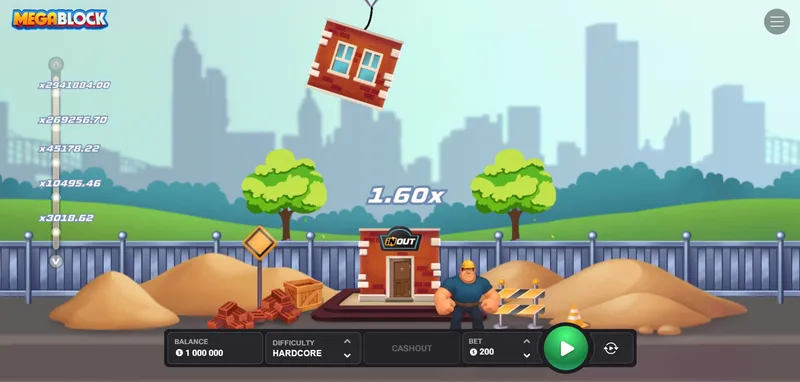
The player selects their bet and difficulty, then presses GO. A block suspended from a crane begins to swing. The player waits for the right alignment and releases. If the block lands correctly, the tower rises and the multiplier increases. If the offset is too great, everything collapses.
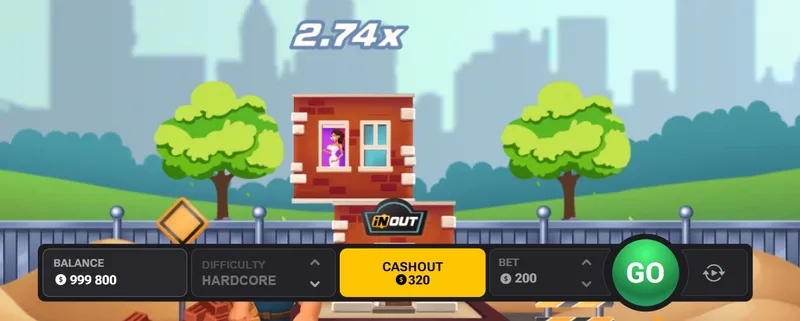
The CASHOUT button remains active as long as the tower stands. Gain = bet × multiplier at the time of cashing out. The speed of oscillation naturally increases with height, making each additional floor more demanding than the previous one.
Free version: test the three modes risk-free
The demo mode requires neither an account nor a deposit. You launch, you play. The starting balance (1,000,000 credits) allows for hundreds of rounds without constraint. The mechanics are strictly identical to the paid version.
On MegaBlock specifically, the demo takes on particular importance thanks to the three modes. Spending fifteen minutes comparing Easy and Hard in demo provides information that real money play cannot offer without cost. What is my average height per mode? At what floor do my mistakes start? Does Medium suit me better than Hard for aiming at x8? The demo answers these questions calmly.
A use I recommend: simulate a complete session in demo with the same budget as in real money. If you plan to play with €25, set 25 credits in demo and follow the same rules. The result will give a realistic idea of what the actual session can produce.
Betting for real on MegaBlock
The game is available on licensed online casinos that integrate the Inout Games catalog. The title being recent, the number of partner platforms will grow over the weeks.
To begin: registration on a proposed casino (email, identity, password), deposit via card, e-wallet, or crypto (minimum generally €10–15), then navigate to the Crash or Turbo section to find MegaBlock.
The first withdrawal triggers KYC verification: ID and proof of address. Withdrawal times: e-wallets in a few hours, cards in one to three days, crypto often under six hours. Always check the thresholds and fees specific to the chosen casino.
95.5% RTP: the glass half full
The payout rate of MegaBlock is below the segment standards. Tower Rush offers 96 to 97% RTP, Aviator around 97% RTP. In the long term, this difference translates to a higher theoretical cost for the player.
But RTP doesn't tell the whole story. In sessions of ten to twenty minutes, it's the variance that dominates. And on MegaBlock, the variance is partly driven by the difficulty choice. A player who smartly exploits Hard (reduced bets, targeted cashouts) can compensate for the lower RTP with coefficients inaccessible in Easy.
Another angle: the difficulty selector introduces an element of skill that RTP does not capture. In a passive crash game (like Aviator), the outcome is purely probabilistic. On MegaBlock, the precision of the action directly influences the ability to reach high multipliers. It's not the same thing.
Legal framework and fairness of the game
MegaBlock operates on a certified RNG, distributed through casinos holding international licenses (MGA, Curaçao, Gibraltar). French legislation does not prohibit access to these platforms. Transactions are encrypted (SSL 256 bits), personal data processed according to GDPR. On casinos offering Provably Fair, each round is individually verifiable.
On mobile, how does it work?
MegaBlock is playable directly in the mobile browser, in HTML5. No app to install. You open the casino site, find the game, and the rounds start.
The touch ergonomics are well calibrated. The GO button and the CASHOUT button are large enough to avoid tap errors. The difficulty selector remains accessible without needing to leave the game screen. I tested on a Samsung Galaxy A55 and an iPhone 13: no slowdowns or display bugs.
The nuance, as with all timing crash games, concerns precision at the end of the round. The finger covers a larger area than a mouse cursor. In Hard, beyond the seventh floor, it's better to anticipate the alignment rather than react at the last moment. Savvy mobile players adjust their cashout threshold accordingly.
On the technical side, data consumption is light. The game does not load video or large files. On stable 4G, the rounds start without delay. The battery does not suffer particularly after about twenty minutes of play.
MegaBlock in the family of crash games
The crash game market is well-stocked in 2026. Aviator laid the foundations, Spaceman added a visual dressing, Tower Rush introduced the concept of block building with in-game bonuses. MegaBlock arrives in this landscape with a minimalist approach but a unique asset that no one else has: adjustable difficulty.
Compared to Tower Rush, the comparison is instructive. Tower Rush offers a higher RTP (96.12–97%) and three bonus mechanics (Frozen Floor, Temple Floor, Triple Build). It's a game richer in content. MegaBlock, on the other hand, bets on raw gameplay, without random crutches, with control of risk level as the only strategic lever. Players looking for mechanical variety will go for Tower Rush. Those who prefer the purity of the action will find satisfaction in MegaBlock.
Compared to Aviator, the difference is fundamental. Aviator is an observation game: you watch a curve rise and decide when to cash out. MegaBlock requires a precise action at each level. The player's skill comes into play directly. For those who find Aviator too passive, MegaBlock brings the physical engagement that was missing.
Recent testimonials
"The crash game I was waiting for. Simple, fast, and especially this adjustable difficulty. I stopped playing Aviator since I discovered MegaBlock."
"I like the construction site design. My partner, who never plays, even looked over my shoulder asking what it was. A good sign."
"Very good on tablet. I alternate between Easy and Hard depending on whether I'm focused or tired. It's the first time a crash game lets me adjust the pace."
"RTP a bit low for my taste, but the gameplay more than makes up for it. I spend my lunch breaks in demo before betting in the evening."
"I hit a x26 on Hard. My record. After that, I got up from my chair and took a break. Impossible to do better that night."
"A nice surprise for a game released two days ago. It lacks bonuses to vary long sessions, but the foundation is solid."
Reminders to keep control
MegaBlock, like any casino game, is designed for entertainment, not for generating revenue. The mathematical advantage is on the house's side. The fast pace of the rounds increases the risk of losing control.
- Session budget set before the first round. When it's exhausted, we close.
- No "catch-up" after a series of missed rounds. Each round is independent.
- Break every ten to fifteen minutes. Accuracy deteriorates with fatigue.
- Use the casino tools: deposit limits, duration reminders, self-exclusion.
- Contact: Players Info Service, 09 74 75 13 13 (7 days a week, non-premium call).
Frequently Asked Questions
Inout Games, a studio specializing in fast games for online casinos.
Inout Games communicates an overall RTP of 95.5% without breakdown by mode. The question remains open.
Yes. MegaBlock is in HTML5, accessible directly in the browser on mobile and desktop.
Completely. Same speeds, same multipliers, same physics. Only the balance is in virtual credits.
Official information does not mention a set cap. The natural limit remains human precision: beyond a certain number of floors, placement becomes nearly impossible.
Not at launch. The game focuses on pure timing gameplay. Future additions are not to be excluded.
No. The RNG is certified and independent. Provably Fair platforms allow verification of each round.

Louis Dubois
Turbo Games Specialist & Player Behavior Analyst
My opinion after several sessions
Note: 4.3 / 5. MegaBlock does not try to do too much. No bonuses, no special mode, no visual overkill. The game focuses on precise timing gameplay, a standout construction aesthetic, and above all, a difficulty selector that transforms the experience. The RTP of 95.5 % remains the point to watch, but for a title launched just a few days ago, the execution is remarkably clean. Inout Games has found an angle that no one had exploited, and the game deserves time to mature.